
通俗易懂-MySQL常用函数解析
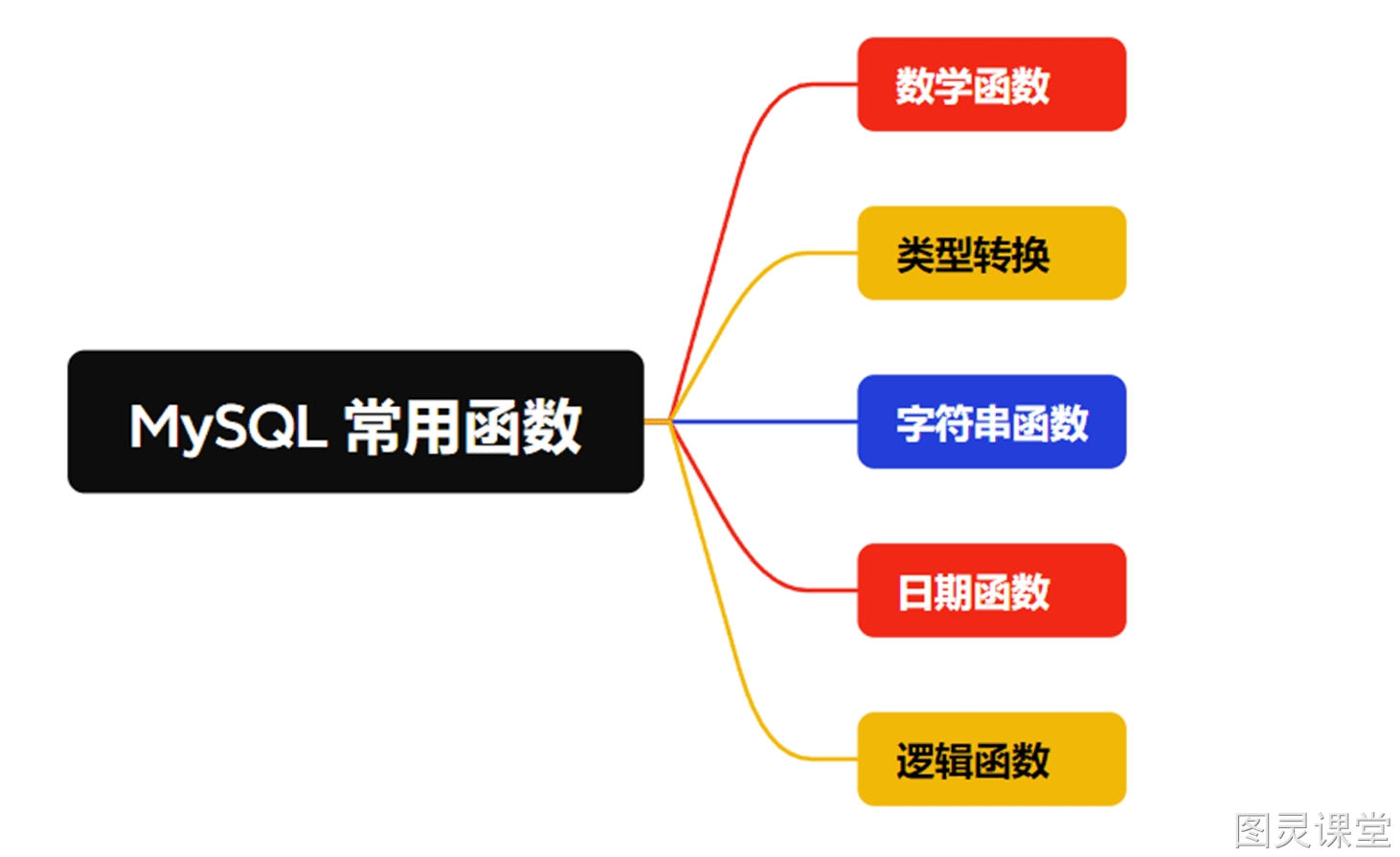
数学函数
count()
count()、count(field) 统计某个结果集中的总数量,field为要统计的字段。
select count( 1 ) from order_details;sum()
sum(field) 统计某个字段累计的总和,field为要统计的字段。
select sum( price ) from order_details;avg()
avg(field) 统计某个字段的平均数,field为要统计的字段。
select avg( price ) from order_details;round()
round(number,x)返回某个数字按指定位数取整后的数字,number被操作的数字,x为精确的位数
# 返回 123.4600
select round(123.4567,2);

# 返回 765.4300
select round(765.4321,2);
abs()
abs(number) 取绝对值
# 返回 88
select abs(-88);
rand()
rand() 返回0-1.0之间的浮点随机数
-- 返回 0.7680746612773041
select rand();
类型转换
cast()
cast(data as type) 将一种类型的数据转换成另一种类型。data为数据, type为类型。
必须是数据库支持的数据类型。
# SIGNED 可以是正数、负数或零
# UNSIGNED 只能是零或正数,不能为负数

# 将字符的123转换成数字的123
SELECT CAST('123' AS SIGNED);
字符串函数
concat()
concat(data1,data2,data3,datan...)拼接字符串。
如果其中一个数据为null则返回null。
# 返回 1234
select concat(1,2,3,4);

# 返回 null
select concat(1,2,3,null);
concat_ws()
concat_ws(separator,data1,data2,data3,datan...) 根据指定的分隔符(separator)拼接字符串,存在null则拼接空白。
# 返回 1,2,3,4
select concat_ws(',',1,2,3,4);
# 返回 1-2-3-4
select concat_ws('-',1,2,3,4);
# 返回 1-2-3
select concat_ws('-',1,2,3,null);
group_concat()
group_concat() 根据某个字段分组然后汇总数据。
create table test (
    id INT,
    name VARCHAR(50)
);

insert into test (id, name) values
(1, '刘备'),
(2, '关羽'),
(3, '张飞'),
(4, '曹操'),
(5, '孙权');

-- 刘备,关羽,张飞,曹操,孙权
select group_concat(name) as names_summary from test;

-- 孙权,曹操,张飞,关羽,刘备
select group_concat(name order by id desc) as names_summary_desc from test;
date_format()
date_format(dateStr,pattern)格式化时间函数。dataStr为要格式化的时间,pattern为格式。
# 返回 2025-03-28
select date_format('2025-3-28 15:33:04',   '%Y-%m-%d');
可以使用的格式有:
格式
描述
%a
缩写星期名
%b
缩写月名
%c
月,数值
%D
带有英文前缀的月中的天
%d
月的天,数值(00-31)
%e
月的天,数值(0-31)
%f
微秒
%H
小时 (00-23)
%h
小时 (01-12)
%I
小时 (01-12)
%i
分钟,数值(00-59)
%j
年的天 (001-366)
%k
小时 (0-23)
%l
小时 (1-12)
%M
月名
%m
月,数值(00-12)
%p
AM 或 PM
%r
时间,12-小时(hh:mm:ss AM 或 PM)
%S
秒(00-59)
%s
秒(00-59)
%T
时间, 24-小时 (hh:mm:ss)
%U
周 (00-53) 星期日是一周的第一天
%u
周 (00-53) 星期一是一周的第一天
%V
周 (01-53) 星期日是一周的第一天,与 %X 使用
%v
周 (01-53) 星期一是一周的第一天,与 %x 使用
%W
星期名
%w
周的天 (0=星期日, 6=星期六)
%X
年,其中的星期日是周的第一天,4 位,与 %V 使用
%x
年,其中的星期一是周的第一天,4 位,与 %v 使用
%Y
年,4 位
%y
年,2 位
length()
length()返回字符串的长度。
# 返回3
select length('123');
replace()
replace()替换指定字符串中的指定字符串为指定字符串
# 返回 aaaaa-abcd
select replace('1234abcd','1234','aaaaa-');
find_in_set()
find_in_set() 查找指定的字符串在不在字符串列表中
-- 返回3,因为找到了
select find_in_set('百里','徐庶,诸葛,百里');

-- 返回0 没找到
select find_in_set('百里1','徐庶,诸葛,百里');
locate()
locate() 返回字符串首次出现的位置,下标从1开始
-- 返回2
select locate('2','123');

-- 返回1
select locate('1','123');
日期函数
curdate()
curdate() 返回今天的日期
-- 返回 2025-03-28
select curdate();
curtime()
curtime() 返回今天的时间
-- 返回 15:42:42
select curtime();
now()
now() 返回日期和时间
-- 返回 2025-03-28 15:43:09
select now();
逻辑函数
if()
if() 判断表达式是否成立,格式if(表达式,成立返回,不成立返回),注意成立和不成立的返回必须是一个类型的,要是字符串必须都是字符串,不能一个是字符串一个是数字。
-- 返回 成立
select if(1=1,'成立','不成立');

-- 返回 成立
select if(1 is not null,'成立','不成立');

-- 返回 不成立
select if(1=2,'成立','不成立');

-- 返回 成立
select if(1 is not null and 1=1,'成立','不成立');

-- 返回 不成立
select if(1 is not null and 1=2,'成立','不成立');
case
case 多表达式判断,返回最先成立表达式的结果,格式CASE WHEN 表达式1 THEN 表达式1成立的结果 WHEN 表达式2 THEN 表达式2成立的结果 ELSE 都不成立的结果 END
-- 返回 1=1
select case when 1=1 then '1=1' when 2=2 then '2=2' else '都不成立' end

-- 返回 2=2
select case when 1=2 then '1=1' when 2=2 then '2=2' else '都不成立' end

-- 返回 都不成立
select case when 1=2 then '1=1' when 2=3 then '2=2' else '都不成立' end
ifnull()
ifnull() 如果传入的值为null,就返回指定的值,不为null,就返回传入的值
-- 返回 1
select ifnull(1,'111');

-- 返回 111
select ifnull(null,'111');